
RapportIQ
Relationship intelligence, built for the way you communicate.
RapportIQ turns the messages, emails, and chats your team is already exchanging into structured signal. Trust scores, risk detection, lifecycle phase, and next-best action. Plug it into any AI agent through the Model Context Protocol.
The platform
LiveChannels
6 sources
Extract
Tone, intent, topics
Memory
Long-term context
Lens
Trust, risk, phase
Graph
People, orgs, topics
Pulse
Health, trends
Coach
Next-best action
Reads the channels you already use, runs on a stack you own
 WhatsApp
 Gmail
Gmail Slack
Slack Microsoft Teams
 Discord
 MCP
MCP PostgreSQL
 Qdrant
 Ollama
What it does
Every conversation, scored. Every relationship, watched.
Most CRMs ask you to log what happened. RapportIQ already knows. Communication arrives from the channels you already use, gets parsed for entities, topics, and intent, lands in a long-term memory keyed to people and organisations, and feeds an analysis layer that scores tone, trust, behaviour, and risk. The result is a live read on every relationship and a coach that tells you what to do next.
See it in action
Relationship intelligence, at work.
A private, self-hosted read on every professional relationship: scored, explained, and turned into the next move.
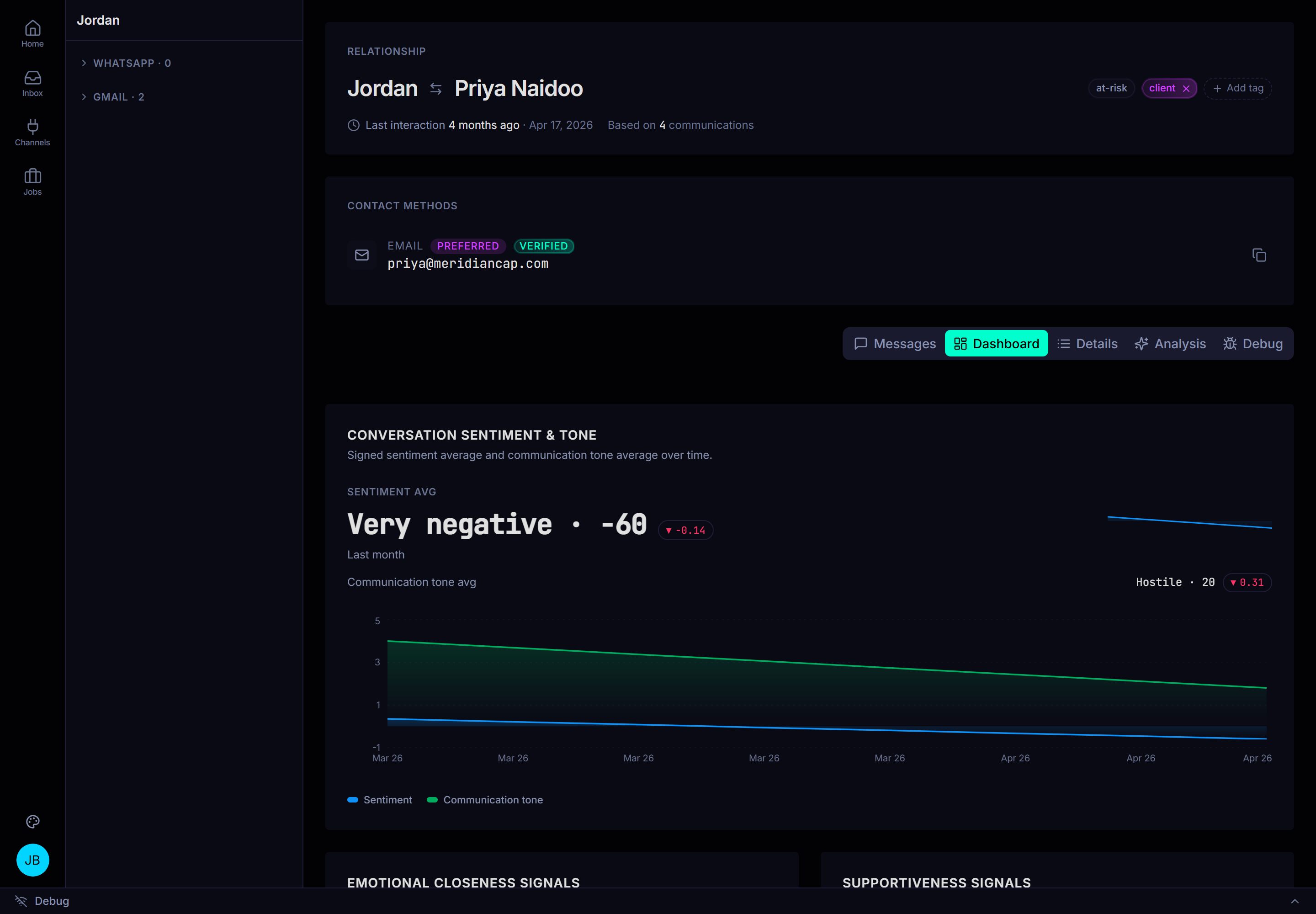
Start with the score
Every relationship scored on health, sentiment, and momentum, tracked over time so you can see which ones are warming and which are going quiet.
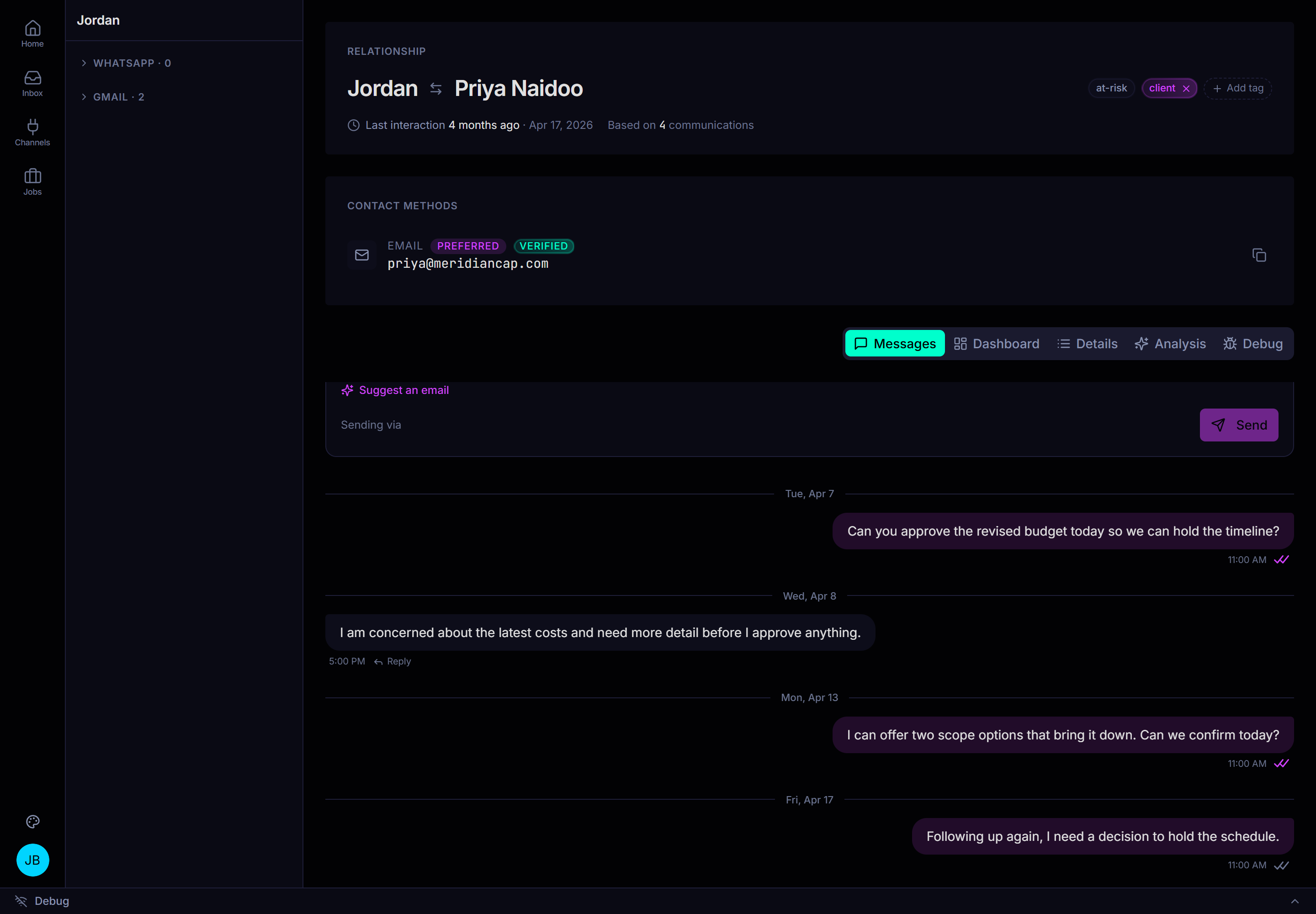
Read the whole relationship
The full thread across every channel in one place, so the history behind the score is one scroll away.
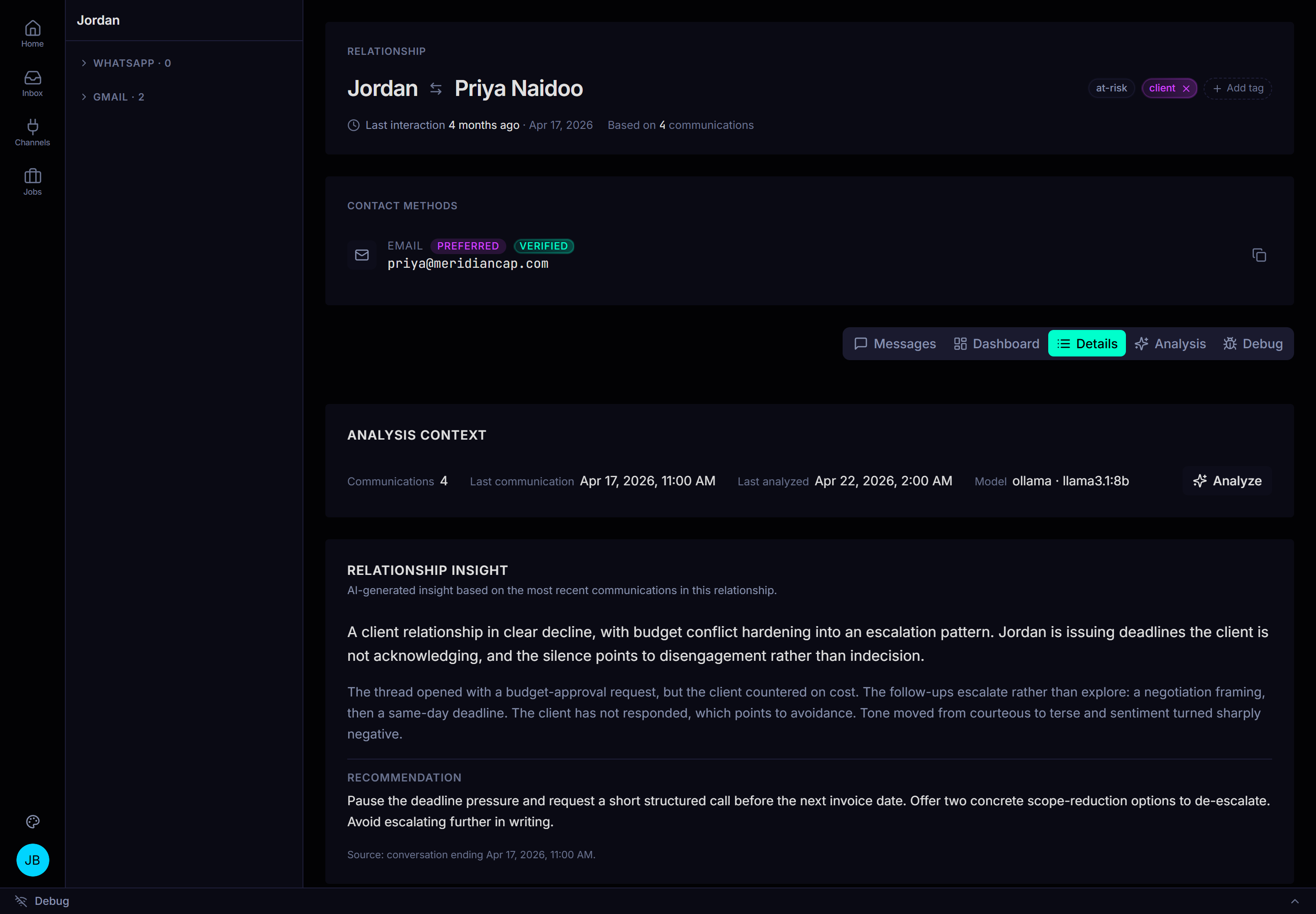
See what the AI made of it
A written read on the relationship: what is happening, why it is happening, and the recommendation, grounded in the conversation it came from.
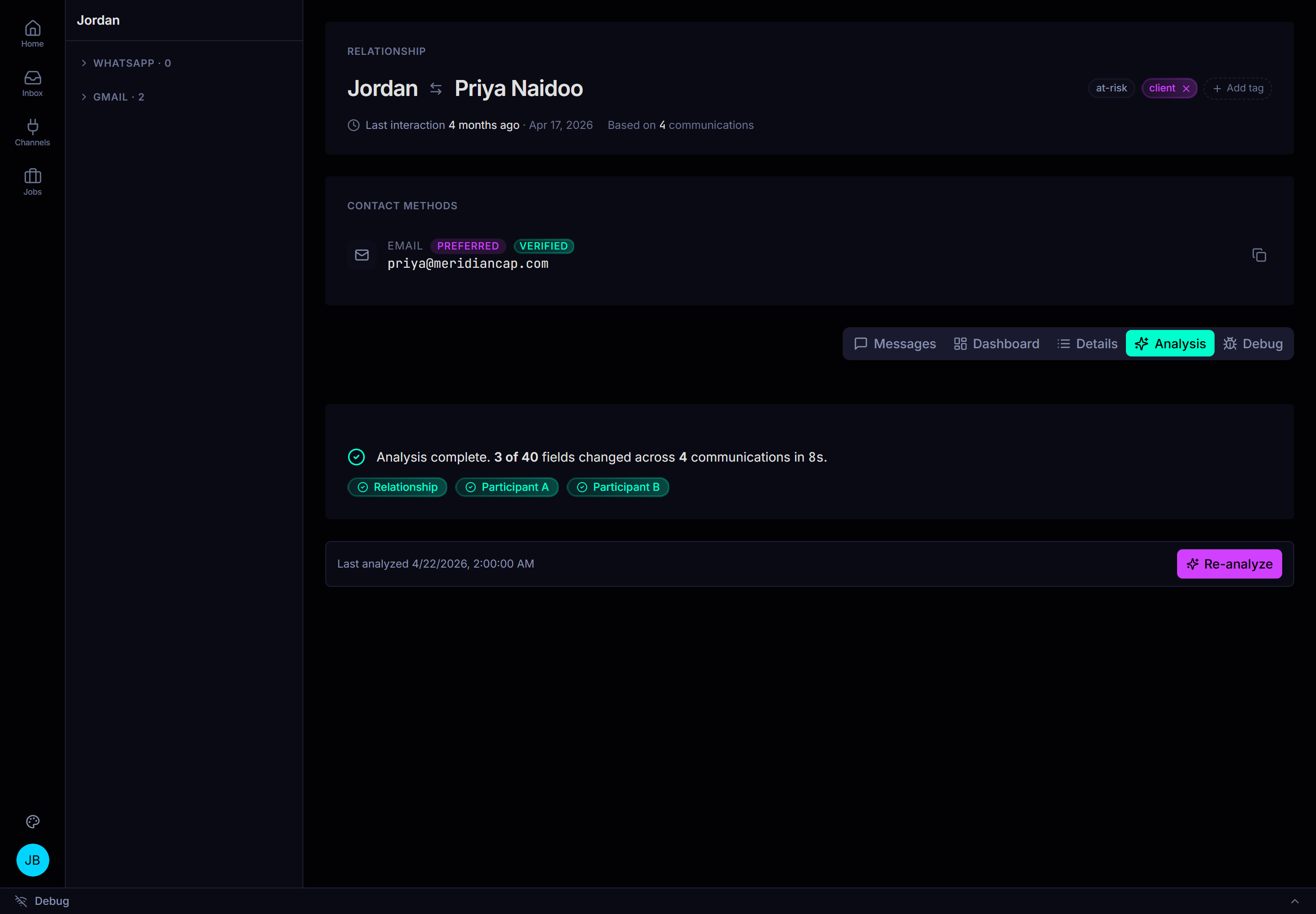
Re-run it whenever you want
Analysis runs on your own model, on your own hardware. Every pass reports what changed and when it last ran.
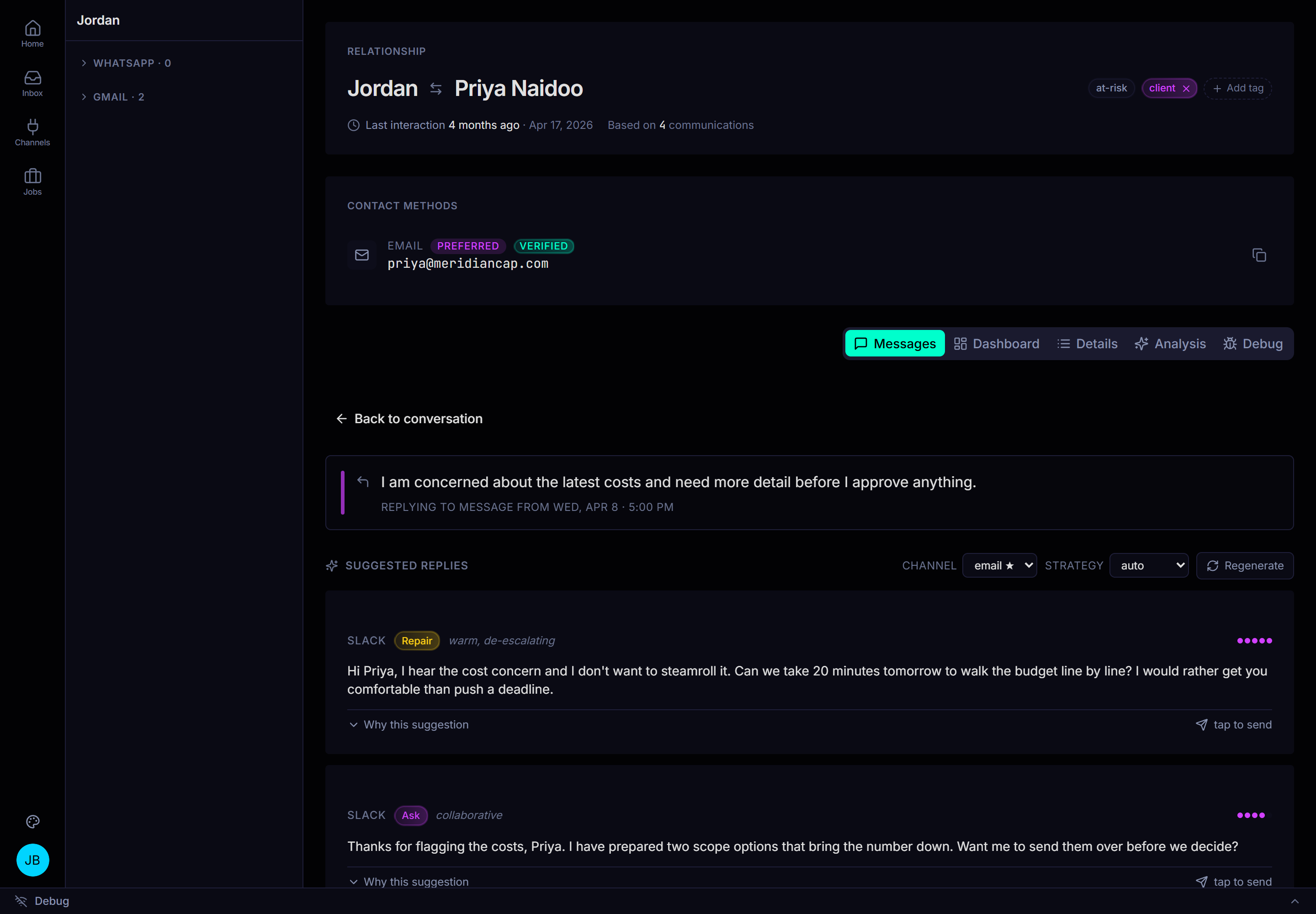
Get the next move, written for you
AI-drafted replies with an intent you choose, so you decide how to handle the relationship and RapportIQ writes to match.
Encrypted end to end, in transit and at rest. Your communications and the database are encrypted, self-hosted in your environment, and stay there.
Inside RapportIQ
Seven modules, one platform.
Channels
Pulls in every conversation from the apps you already use.
Extract
Reads each message for what it really says: entities, topics, intent.
Memory
Remembers everyone, every promise, every shift in tone.
Lens
Scores every interaction for trust, risk, and emotional weight.
Graph
Maps how your people, deals, and topics are actually connected.
Pulse
Surfaces the relationships drifting away before they break.
Coach
Tells you who to message and what to say, right now.
Where it listens
Meet people on the channels they already use.
RapportIQ ingests from the messaging, email, and chat sources that carry real conversations. No new tool for users to adopt.
Personal
- WhatsApp
- iMessage
Workplace
- Slack
- Microsoft Teams
- Gmail
Community
- Discord
Built for AI agents
Plug in. Don't integrate.
RapportIQ speaks the Model Context Protocol natively. Connect Claude, GPT, or your own agent. They all use the same six tools to resolve people, log conversations, and pull relationship intelligence. No bespoke adapters. No drift between your AI and your data.
- Streamable HTTP transport. Standard MCP SDK.
- Channel agents stay thin. Domain rules live in one place.
- Idempotent ingestion. Replay-safe by design.
Tool surface
v1.x SDKcreate_organizationRegister a canonical account record.create_personAdd a contact with channels and identity.find_person_by_contactResolve an email, handle, or number to a person.find_relationship_by_contactsMap two contacts to a relationship.create_communicationIngest a message under the canonical pipeline.list_supported_channelsDiscover what's accepted.
Six tools. Streamable HTTP. Official MCP SDK. Drop your agent in, start operating.
Research first
Every method has a source.
We're a lab. We use published datasets and methods, pin the exact versions, and publish how we tested.
- [01] EACL · 2024
RAGAS: Automated Evaluation of Retrieval Augmented Generation
Es et al. (2024)
Backs: Summary and suggestion gates. Faithfulness and AnswerRelevancy are RAGAS metrics, shipped via DeepEval.
- [02] EMNLP · 2023
G-Eval: NLG Evaluation Using GPT-4 with Better Human Alignment
Liu et al. (2023)
Backs: Lens scoring. G-Eval is the general-purpose LLM-judge metric the evaluation worker runs.
- [03] NeurIPS Datasets and Benchmarks · 2023
Judging LLM-as-a-Judge with MT-Bench and Chatbot Arena
Zheng et al. (2023)
Backs: LLM-as-judge formulation. How Extract, Lens, and Coach scores are produced.
- [04] arXiv · 2024
LLM Evaluators Recognize and Favor Their Own Generations
Panickssery, Bowman, Feng (2024)
Backs: Self-preference mitigation. The startup check that refuses judge model equals chat model.
- [05] arXiv · 2023
Towards Understanding Sycophancy in Language Models
Sharma et al. (2023)
Backs: Bias mitigation. Neutral framing in custom-metric criteria avoids sycophantic judge behaviour.
- [06] ICLR · 2020
BERTScore: Evaluating Text Generation with BERT
Zhang et al. (2020)
Backs: Offline regression batches. Reference-based scoring against an authored calibration set.
- [07] IEEE TPAMI · 2018
Efficient and Robust Approximate Nearest Neighbor Search Using Hierarchical Navigable Small World Graphs
Malkov and Yashunin (2018)
Backs: Memory module. pgvector and HNSW is how relationship memory is searched at scale.
Citations include preprints alongside peer-reviewed work. We interpret current LLM-agent research alongside established cognitive science, databases, and information retrieval.